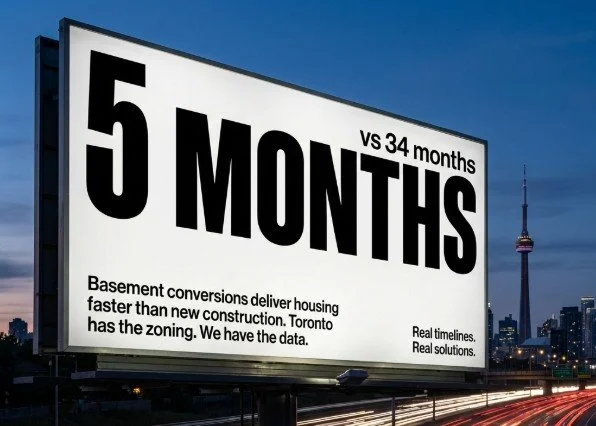
TL;DR: Converting existing Toronto homes into multi-unit dwellings delivers housing faster (5-8 months versus 14-34 months), costs less ($100,000-$300,000 versus new builds), produces 90% less carbon emissions, and works within existing zoning. The barrier is financing access, not technical capacity.
Core Answer:
Property conversions add housing units in 5-8 months total (2 months permit + 3-6 months construction) versus 14-34 months for new builds
Basement conversions cost $100,000-$300,000 compared to higher per-unit costs for new construction
Conversion projects produce only 8 tons CO2 equivalent versus 80 tons for new builds
Toronto zoning allows up to 4 units per property, minimum 188 square feet per suite
Policy gap: homeowners need better financing options specifically designed for conversion projects
Conversions, not new homes, will solve the housing crisis faster
Prime Minister Mark Carney's Build Canada Homes initiative targets new affordable home construction. The plan addresses housing shortage through traditional building methods.
The timeline doesn't match Toronto's urgency.
We've built homes across Toronto for the last decade. Our project database tracks every build, every conversion, every timeline. The data shows a faster path exists.
What Is the Actual Timeline Difference Between New Construction and Conversion?
New home construction requires 14 to 34 months from permit approval to occupancy. Break that down: 6 months to 2 years for permits, then 8 to 16 months of construction. Larger developments take longer.
Toronto families priced out of the market need housing now, not in three years.
Converting existing structures works faster. A basement becomes a legal secondary suite in 5 to 8 months total. The City of Toronto fast-tracks secondary suite permits to 2 months. Construction takes 3 to 6 months when working within an existing structure.
If a fraction of existing Toronto homes added an accessory dwelling unit or secondary suite, thousands of new rentable dwellings would be available by mid-2026.
Timeline Comparison
New build permit approval: 6 to 24 months
Conversion permit approval: 2 months (City of Toronto fast-track)
New build construction: 8 to 16 months
Conversion construction: 3 to 6 months
Total new build: 14 to 34 months
Total conversion: 5 to 8 months
Speed Advantage: Conversions deliver housing units 9 to 26 months faster than new construction.
What Underutilized Housing Stock Exists in Toronto Right Now?
Toronto has underutilized residential space available for conversion today. Basements with accessible ceiling heights. Garages suitable for laneway suites. Single-family homes in neighborhoods where zoning allows up to four units per property.
The Ontario Building Code (OBC) sets the minimum size for a secondary suite at 188 square feet. You don't need a large budget to start generating rental income on your property.
Conversion Project Cost Range (Toronto)
Basement conversions: $100,000 to $300,000
Cost factors: underpinning requirements, existing ceiling heights, square footage, scope of work
Minimum suite size: 188 square feet (OBC requirement)
These projects move fast when working within an existing structure. Toronto homes are built well enough to handle these conversions. Reusing foundations, load-bearing walls, and existing infrastructure instead of building from scratch saves time.
Bottom Line: Existing Toronto housing stock provides immediate conversion opportunities without waiting for new construction timelines.
How Do Environmental Impacts Compare Between Conversion and New Construction?
New construction consumes concrete, lumber, and materials at scale. When you work within an existing structure, you use less new materials because you're preserving foundations, load-bearing walls, and infrastructure.
The Carbon Footprint Comparison
Refurbishment/conversion: 8 tons CO2 equivalent
New construction: 80 tons CO2 equivalent
Carbon savings: 90% reduction through conversion projects
Material reuse: existing foundations, structural elements, infrastructure
The buildings and construction sector accounts for 37% of global greenhouse gas emissions. Conversion over new construction reduces environmental impact while adding housing supply.
Renovation projects save approximately 50% of carbon emissions by preserving existing structure and foundation compared to demolition and rebuild scenarios.
Environmental Advantage: Property conversions deliver housing units while substantially reducing material consumption and carbon emissions.
Why Does Housing Policy Overlook Property Conversions?
Current housing policy focuses on developers building new construction. Federal programs emphasize construction targets and affordable housing mandates for new builds.
Enabling existing property owners to add units receives less policy attention.
Existing Policy Framework (Ontario/Toronto)
City of Toronto zoning: up to 4 residential units allowed in all residential neighborhoods
Ontario Planning Act: mandates all municipalities allow ADUs (Accessory Dwelling Units) in zoning regulations
Permit fast-tracking: City of Toronto processes secondary suite permits in 2 months
The infrastructure exists. The policy framework exists. The technical capacity exists.
The financing gap is the barrier.
Homeowners need grants and better financing instruments specifically designed for conversion projects. The government should work with CMHC (Canada Mortgage and Housing Corporation) to create better access to financing options for adding units onto existing properties.
A homeowner adding a secondary suite faces the same financing challenges as someone building new. The timeline differs (5-8 months versus 14-34 months). The risk profile differs. The financing structure should reflect these differences.
Policy Gap: Zoning and permits support conversions, but financing options lag behind the opportunity.
How Do Property Conversion Economics Work?
Adding income-producing units increases property value. The value increase sometimes matches construction costs, sometimes falls short.
ADUs rank among the most costly conversion projects. Secondary suites within existing structures have better odds of matching construction costs with added property value.
The Financing Math (Current Toronto Market)
Borrowing power formula: $1,000 monthly rental income = $6,000 additional borrowing power
Example: $1,500/month secondary suite = $9,000 increased buyer qualification amount
Annual rental income: $12,000 per year from $1,000/month suite
The financing formula provides baseline calculations. The sale price depends more on how buyers value the rental income stream. Buyers often place higher value on rental income than strict borrowing power calculations suggest.
The Multi-Generational Housing Comparison
ADU option: split property expenses, add family member housing on existing lot
Condo option: separate property taxes, condo fees, maintenance costs
Trend: multi-generational families choosing ADUs over condo purchases
Financial Reality: Income-producing units increase property value and provide rental income, with returns varying by project type and market conditions.
What Specific Changes Would Unlock Property Conversions?
The barrier is information and financing, not technical capacity. Toronto has the homes. Zoning allows the conversions. Contractors know how to complete the work.
Current Homeowner Barriers
Lack accurate cost estimates before committing to projects
Limited access to financing designed for conversion timelines and risk profiles
Uncertainty about what prevents basement or property conversion
We estimate costs for secondary suites and multi-unit development projects using our construction costing database built over the last decade. The costs are accurate before you start designing.
What Homeowners Need
Transparent cost information before commitment
Clear timelines (2 months permit + 3-6 months construction)
Realistic budgets ($100,000-$300,000 for basement conversions)
Financing products matching conversion project risk and timeline
The federal government could unlock thousands of housing units by shifting focus from exclusively funding new construction to enabling property conversions.
Required Change: Information transparency and conversion-specific financing remove the barriers preventing homeowners from adding housing units.
How Should Housing Policy Shift to Address Toronto's Urgency?
Building new homes matters. New construction should continue.
The fastest path to adding housing supply in Toronto runs through homes already built.
The timeline advantage is measurable (9 to 26 months faster). The environmental benefit is quantifiable (90% carbon reduction). The policy framework exists (zoning allows 4 units per property).
Government housing policy needs a shift. Stop treating every solution as new construction. Start enabling property owners who could add units within months instead of years.
Toronto families need housing now. Conversion projects deliver speed. New construction delivers volume over longer timelines.
Toronto doesn't need to wait for Build Canada Homes to deliver results in 2028 or 2030. The city could see thousands of new dwelling units by 2026 if policy shifted to empower homeowners converting existing space.
Our construction database tracks timelines, costs, and outcomes across hundreds of projects. The data supports conversion as the faster path.
Strategic Question: If conversion delivers housing units faster and within existing infrastructure, why does policy prioritize only new construction?
Frequently Asked Questions About Property Conversions in Toronto
How long does basement conversion take from start to finish?
A basement conversion to legal secondary suite takes 5 to 8 months total. The City of Toronto fast-tracks secondary suite permits to 2 months. Construction takes 3 to 6 months depending on existing ceiling heights, underpinning requirements, and scope of work.
What does basement conversion cost in Toronto?
Basement conversions range from $100,000 to $300,000. Cost depends on underpinning requirements, existing ceiling heights, square footage, and scope of work. Projects with accessible ceiling heights cost less than those requiring underpinning.
Do I need special permits for adding secondary suite?
Yes. The City of Toronto requires permits for secondary suites. The advantage is fast-track processing (2 months versus 6 to 24 months for new construction permits). Secondary suites must meet Ontario Building Code minimum 188 square feet.
How much rental income does secondary suite generate?
Rental income varies by location, size, and amenities. A secondary suite in Toronto rents for $1,500 to $2,500 per month depending on these factors. Every $1,000 monthly rental income adds approximately $6,000 to property borrowing power at current interest rates.
Does adding secondary suite increase property value?
Income-producing units increase property value. The value increase sometimes matches construction costs, sometimes falls short. Secondary suites within existing structures are more likely to match costs with value compared to ADUs. Property buyers often value rental income higher than strict borrowing power calculations suggest.
What zoning allows multi-unit conversions in Toronto?
City of Toronto zoning allows up to 4 residential units in all residential neighborhoods. The Ontario Planning Act mandates all municipalities allow ADUs (Accessory Dwelling Units) in zoning regulations. Check specific property zoning before starting conversion projects.
What prevents homeowners from converting property now?
Two barriers block homeowners: information and financing. Most homeowners lack accurate cost estimates before committing. Financing designed for conversion project timelines and risk profiles is hard to access. Technical capacity exists. Zoning allows conversions. The gap is transparent information and appropriate financing products.
Are conversions better for environment than new builds?
Conversion projects produce approximately 8 tons CO2 equivalent versus 80 tons for new construction (90% reduction). Conversions reuse existing foundations, structural elements, and infrastructure. Less concrete, lumber, and new materials reduces environmental impact substantially.
Key Takeaways
Property conversions deliver housing units 9 to 26 months faster than new construction (5-8 months versus 14-34 months total timeline)
Basement conversions cost $100,000 to $300,000 with 2-month fast-track permits in Toronto versus longer timelines and higher costs for new builds
Conversion projects produce 90% less carbon emissions (8 tons versus 80 tons CO2 equivalent) by reusing existing structures
Toronto zoning allows up to 4 units per property with minimum 188 square feet per suite under Ontario Building Code
The policy gap is financing access, not technical capacity or zoning restrictions. Government needs conversion-specific financing products through CMHC
Every $1,000 monthly rental income adds $6,000 borrowing power, but buyers often value income streams higher than strict calculations
If a fraction of Toronto homes added secondary suites or ADUs, thousands of rentable units would be available by mid-2026 versus waiting until 2028-2030 for new construction programs



About BVM COntracting
BVM Contracting is a full-service General Contractor or Home Builder located in Toronto. We provide home renovation and building services for major home renovations and custom home builds (full interior renovations, home additions, lot severances, new home construction, garden suites, and laneway suites). Our goal is to help guide our clients through the process of building their home, from concept to completion.
Further than providing General Contracting and Project Management for major home renovations, we also offer value-added services such as renovation financing, renovation rebate consultations and services, building permit and design services, smart home installation services, and real estate investor services.
To learn more about our offering by visiting our services page. Learn more about our vision, mission, and values here.