Here’s how you figure out which home addition contractor near you is best for your project
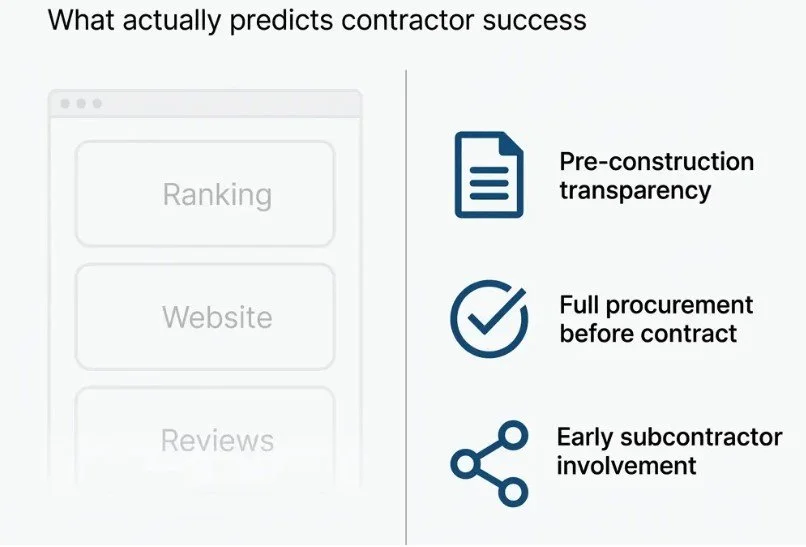
TL;DR: When you search "best home addition contractors near me," you're seeing companies with strong digital marketing, not necessarily the best fit for your project. The variables that predict success (pre-construction transparency, full procurement before contract signing, early subcontractor involvement) don't show up in search results or initial quotes. This article shows you what to evaluate and how to go deeper into evaluating local home addition contractors for your home addition project.
What you need to know:
Search rankings reflect digital marketing investment, not project success rates
Pre-construction transparency matters more than proximity, price, or availability
Full procurement (actual subcontractor quotes before you sign) prevents budget surprises
Early contractor involvement in design catches expensive problems before they become change orders
Family-owned scale allows deeper pre-construction work than volume contractors
What Search Results Don't Tell You About Local Home Addition Contractors
You search "best home addition contractors near me in Toronto" and get pages of results. Or maybe you asked ChatGPT or Gemini and it spat out some names.
Clean websites. Professional photos. Confident testimonials.
You're seeing companies that invested in SEO and digital marketing. Search ranking and project success do not always correlate.
Contractors who show up first are optimized for the search algorithms. Contractors who deliver successful projects optimized for something else entirely. Yes, you can have good digital marketing AND be a good home addition contractor, that is not the argument here. The argument is that you should not just trust that the companies being recommended or that show up first are the greatest fit for your home addition project.
The information you need to make a good decision isn't all in the search results. You need to look deeper to find out which home addition contractor is the best option for your project.
What "Best" Means for Home Addition Contractors
Most homeowners optimize for the wrong variables:
Proximity. You want someone local who knows Toronto, and maybe even has done a project or two in your neighbourhood.
Price. You compare quotes and pick the lowest or middle option. You assume highest prices aren’t interested in your project.
Availability. You want to start as soon as possible.
These feel logical. They're the wrong variables to focus on though.
What predicts whether your home addition stays on budget and finishes without disputes:
Pre-construction transparency. Does the contractor provide detailed cost breakdowns before you commit? Or do they give you a per-square-foot estimate and promise to "figure it out during design"?
Full procurement before contract signing. Has the contractor gotten quotes from subcontractors for your specific project? Or are they estimating based on gut feel and past averages?
Early involvement in design. Does the contractor review architectural plans before they're finalized? Or do they show up after permits are approved and tell you the budget just doubled?
These three variables separate contractors who profit from clarity from contractors who profit from confusion.
Transparency in pre-construction planning predicts project success better than proximity, price, or start date.
How the Information Gap Costs Toronto Homeowners Thousands
The pattern repeats across Toronto home addition projects.
You hire an architect or designer. They create beautiful plans. You're excited.
You send those plans to contractors for quotes.
The quotes come back 40% higher than expected. Or worse, they come back reasonable or lower than expected, you sign the contract, and the change orders start piling up.
This happens because of a structural problem in how the industry operates.
Most contractors estimate using per-square-foot costs. They have a mental database. Additions cost $350 to $500 per square foot in Toronto. Kitchens cost one amount. Bathrooms another.
These estimates achieve about 80-90% accuracy on straightforward projects.
Home additions in Toronto are rarely straightforward.
You're dealing with existing conditions. Older homes with unknown foundation depths. Utility upgrades that depend on how many units you're adding. Zoning variances that require Committee of Adjustment applications.
Per-square-foot estimates miss these variables entirely.
You commit to a contractor based on incomplete information. By the time you discover what the project costs, you're locked in.
Per-square-foot estimates work for straightforward projects. Toronto home additions involve existing conditions that make these estimates 90% accurate at best, leaving you exposed to thousands in unexpected costs.
What Full Procurement Looks Like in Practice
Some home addition contractors operate differently.
Before you sign anything, they bring in the subcontractors who will work on your project. The foundation specialist looks at your existing footings. The electrician evaluates your panel capacity. The HVAC team assesses whether your current system handles additional square footage.
This isn't a courtesy. It's a different business model.
Instead of estimating what things might cost, they determine what things will cost.
The difference shows up in two places:
Accuracy. When you get a quote based on actual vendor pricing for your specific conditions, the number doesn't change unless you change the scope.
Discovery. Early subcontractor involvement catches problems before they become expensive surprises.
Example from a Toronto two-story addition project:
The initial architectural drawings assumed underpinning work (digging beneath the existing foundation to extend it deeper). Standard approach. Estimated cost for underpinning: $65,000.
When our foundation contractor came in during pre-construction, they discovered the existing basement footings sat 16 inches lower than the slab. That depth meant no underpinning needed.
Our client saved $30,000. They used that money to upgrade kitchen finishes and add a second-level bathroom.
That discovery happened because we involved specialists before finalizing the budget.
Most contractors don't operate this way. It requires more upfront work. It delays the contract signing. You might walk away after seeing real numbers.
It's the only way to know what you're committing to.
Full procurement brings subcontractors in before you sign a contract. This catches expensive problems (like unnecessary underpinning work) and gives you fixed pricing based on your actual conditions, not industry averages.
Questions That Reveal How a Contractor Operates
When you talk to contractors, ask these specific questions. The answers tell you whether they profit from transparency or opacity.
"Do you provide line-item cost breakdowns, or just a total project price?"
If they only give you a total, you don't see where your money goes. When costs increase, you don't know if the change is reasonable.
"Do you estimate the full project cost, including permits, architectural fees, and utility upgrades, or just the construction work you're managing?"
Many contractors quote only their portion. You discover the other $15,000 to $25,000 in soft costs after you've committed. Then you figure out the costs of your own finishes on top of that.
"Do you get actual quotes from subcontractors before I sign a contract, or do you estimate based on per-square-foot costs?"
This question separates contractors who fully procure projects from contractors who estimate and adjust later.
"When do you get involved in the design process (before or after architectural plans are finalized)?"
If they only see plans after permits are submitted, they don't prevent budget blowouts. They react to them.
"What happens if we discover existing conditions that weren't visible during initial assessment?"
The answer reveals whether they build contingency into their process or treat surprises as automatic change orders.
These questions make some contractors uncomfortable. That discomfort is information.
Contractors who provide detailed breakdowns, estimate full project costs (not just their portion), get actual subcontractor quotes, and involve themselves early in design are structurally different from contractors who withhold information until you're committed.
Why Family-Owned Scale Matters for Home Additions
You might assume bigger contractors have more resources and deliver better results.
The opposite is often true for residential additions.
Large contractors optimize for volume. They need to keep crews busy across multiple projects. That creates pressure to move fast, start before all details are resolved, and handle problems reactively.
Family-owned contractors operating at smaller scale do something volume players don't: overinvest in pre-construction.
They spend weeks getting every subcontractor quote finalized before you commit. They walk away from projects that don't fit their methodology. They maintain relationships with the same specialists across years, which means those specialists show up when called.
This isn't about warmth or personal touch. It's about structural advantages that come from not chasing growth.
When a contractor's reputation is their primary asset and they only take on 8 to 12 projects per year, they can't afford to have one go badly. That changes how they operate during the phase that matters most (before construction starts).
Family-owned contractors at smaller scale have structural advantages in home additions. They overinvest in pre-construction planning because reputation (not volume) drives their business model.
Why Pre-Construction Determines Project Success for home additions
Most homeowners focus on construction quality. They ask about warranties, timelines, and crew experience.
Those things matter. They're downstream of the variable that determines success.
Pre-construction planning prevents the problems that construction quality doesn't fix.
When scope is vague, even excellent crews don't deliver on budget. When existing conditions aren't properly assessed, even the best project manager doesn't prevent surprises. When subcontractors aren't involved early, even detailed contracts don't eliminate disputes.
Contractors who understand this don't rush to start building. They invest time upfront getting every detail resolved.
That investment shows up as:
Detailed cost breakdowns that include everything (not just construction labor)
Actual vendor quotes for your specific project conditions
Architectural review before plans are finalized
Exploratory work to assess existing conditions
Clear documentation of what's included and what's not
This work happens before you sign a contract. In many cases, it happens before you've decided to hire them.
Contractors who provide value before commitment are structurally different from contractors who withhold information until you're locked in.
Pre-construction planning (detailed breakdowns, actual quotes, architectural review, exploratory work) prevents the problems that construction quality alone won't fix. Scope clarity eliminates the disputes and budget blowouts that derail home addition projects.
How to Evaluate Home Addition Contractors in Toronto
The next time you search for home addition contractors in Toronto, look past the search rankings.
Evaluate based on the variables that predict success:
Do they provide detailed cost transparency before you commit? If no, keep looking.
Do they fully procure projects with actual subcontractor quotes? If they estimate based on per-square-foot costs, you're taking on risk they should be managing.
Do they get involved during design, or only after plans are finalized? Late involvement means late discovery of budget problems.
Do they operate at a scale that allows meticulous pre-construction work? Volume contractors don't invest the time this phase requires.
These questions filter for contractors who've built their business model around the phase that matters most.
You're not looking for the contractor with the best website or the fastest start date.
You're looking for the contractor who treats pre-construction as the product and construction as the proof.
Search rankings show marketing investment, not project success. Evaluate contractors on pre-construction transparency, full procurement, early design involvement, and scale that allows meticulous planning.
Key Takeaways: Choosing Home Addition Contractors in Toronto
Search rankings reflect digital marketing investment, not project success rates or contractor quality
Per-square-foot estimates achieve 90% accuracy on straightforward projects but miss existing conditions (foundation depths, utility capacities, zoning requirements) that define Toronto home additions
Full procurement means getting actual subcontractor quotes before you sign a contract, giving you fixed pricing based on your specific conditions instead of industry averages
Early subcontractor involvement catches expensive problems (like unnecessary underpinning work) before they become change orders that blow your budget
Pre-construction transparency (detailed breakdowns, full project costs, actual quotes) separates contractors who profit from clarity from those who profit from confusion
Family-owned contractors operating at smaller scale (8 to 12 projects per year) overinvest in pre-construction planning because reputation drives their business model
The questions you ask (about breakdowns, procurement, design involvement, existing conditions) reveal whether a contractor's business model aligns with your need for budget certainty
Frequently Asked Questions About Home Addition Contractors in Toronto
How much should pre-construction services cost in Toronto?
Pre-construction agreements typically range from $1,500 to $4,000 plus HST. Some contractors apply this fee toward your project if you proceed. Others provide initial consultations at no cost. The fee structure matters less than whether the contractor does the work (getting subcontractor quotes, reviewing architectural plans, assessing existing conditions).
What's the difference between a cost estimate and full procurement?
A cost estimate uses historical data and per-square-foot averages to predict what your project might cost. Full procurement means the contractor gets actual quotes from the specific subcontractors and vendors who will work on your project. Estimates give you a range. Procurement gives you a fixed price that only changes if you change the scope.
Why don't all contractors involve subcontractors early?
It takes more time and delays contract signing. Many contractors optimize for speed to contract rather than accuracy of estimate. They start fast and handle surprises through change orders instead of investing weeks in pre-construction planning. This approach works because most homeowners don't know to demand full procurement upfront.
How do I know if my existing home conditions will cause problems?
You don't, unless a contractor does exploratory work before quoting. Older Toronto homes often have foundation depths, utility capacities, and structural conditions that aren't visible without investigation. Contractors who provide accurate quotes do this assessment during pre-construction. Contractors who estimate based on assumptions discover problems after you've signed.
What should I look for in a contractor's website to evaluate their approach?
Look for educational content that explains their process in detail. Do they write about pre-construction planning? Do they explain what full procurement means? Do they break down the soft costs most contractors omit? Informative websites signal the company values client education. Generic marketing language signals they're optimizing for search rankings instead of informed client decisions.
Is it normal for contractors to provide detailed cost breakdowns before I commit?
It should be normal, but it's rare. Most contractors provide a total project price with minimal detail. Contractors who provide line-item breakdowns are making a strategic choice. They're competing on transparency instead of appearing to have the lowest price. That transparency costs them some clients who want the cheapest option, but it attracts clients who value certainty.
What are soft costs in home addition projects?
Soft costs are expenses beyond construction labor and materials. These include permits, architectural fees, engineering reports, Committee of Adjustment applications ($2,126 to $6,187 plus representation fees in Toronto), utility upgrades, and temporary services during construction. Many contractors quote only construction costs and leave you to discover soft costs (often $15,000 to $25,000) after you've committed.
How long does pre-construction planning take for a home addition in Toronto?
Pre-construction planning typically takes 1 to 2 months when done properly. This includes getting subcontractor quotes, reviewing architectural plans, assessing existing conditions, and finalizing detailed cost breakdowns. Contractors who skip this phase or rush through it in days are estimating based on averages instead of your specific conditions.





About BVM COntracting
BVM Contracting is a full-service General Contractor or Home Builder located in Toronto. We provide home renovation and building services for major home renovations and custom home builds (full interior renovations, home additions, lot severances, new home construction, garden suites, and laneway suites). Our goal is to help guide our clients through the process of building their home, from concept to completion.
Further than providing General Contracting and Project Management for major home renovations, we also offer value-added services such as renovation financing, renovation rebate consultations and services, building permit and design services, smart home installation services, and real estate investor services.
To learn more about our offering by visiting our services page. Learn more about our vision, mission, and values here.