TLDR: Most Toronto homeowners — and even some contractors — default to expensive traditional foundations for ADUs without ever evaluating the alternatives. Helical piers can cut your foundation cost nearly in half on a single-level ADU, but site access, soil conditions, and how many storeys you're building all drive the decision. Here's how we actually think through it.
The Foundation Decision Most Homeowners Never Think About
You've got the drawings approved. The permit is in. Everyone's excited about the new ADU in the backyard. And then someone brings up the foundation — and suddenly nobody really knows what they're talking about.
Here's the pattern we see over and over: homeowners and architects assume a traditional poured concrete foundation is the only option, or they don't ask enough questions early on, and the project gets priced accordingly. Then the quote comes back and it's $25,000 just for the foundation. That number sticks, and no one questions whether a cheaper, faster, equally sound alternative was ever on the table.
ADU foundation options in Toronto aren't one-size-fits-all. The right answer depends on the size of your structure, how many floors you're building, what your soil looks like, how accessible your backyard is, and how you want to handle utilities. Get this decision right early, and it changes the economics of the whole project.
The Three ADU Foundation Types We Actually Use
We've built ADUs in Toronto using three different foundation approaches. Each one has a legitimate use case — and each one has conditions where it falls apart.
Helical Piers
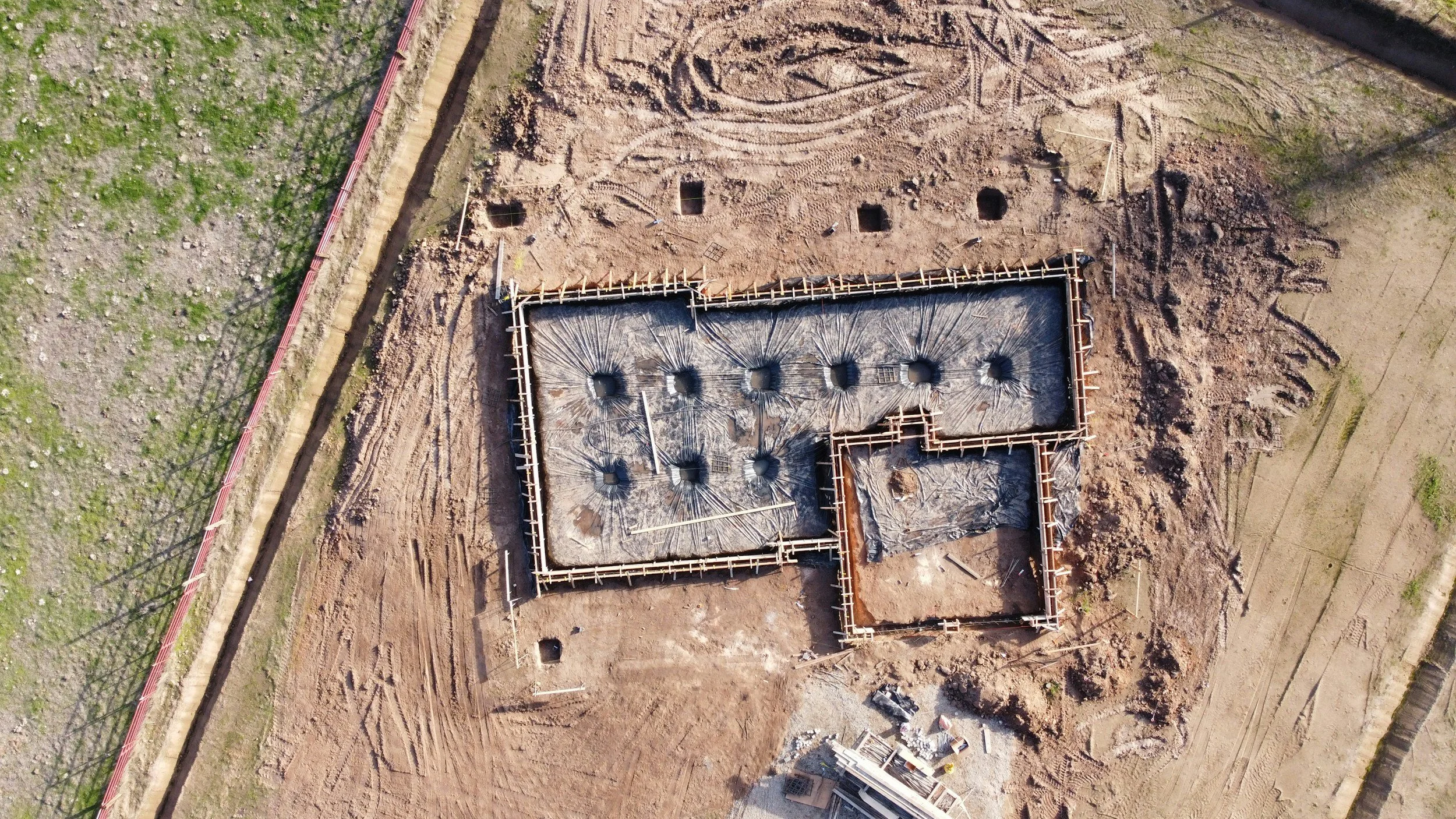
Helical piers are steel screw-piles driven into the ground using a small piece of equipment. They're our preferred option for single-level ADUs, and it's not close. We've completed two ADU foundations using helical piers, and the advantages are real.
The setup is faster than traditional excavation — you're not waiting on concrete cures, you're not moving large volumes of soil, and you don't need a large excavator to access the backyard. On a 500 sq ft ADU, we've priced helical piers at approximately $16,000 versus $25,000 for a traditional system (excavation, footings, foundation wall, concrete slab). That's a $9,000 difference on the foundation alone.
There are trade-offs. Because the structure sits elevated above grade, the floor system is technically exposed to the elements underneath. That means two things: first, the underside of the floor assembly needs to be insulated properly. Second, utilities — especially the water supply line — need to be protected against Toronto's frost depth, which sits around 4 feet. Neither of these is a dealbreaker. They just need to be designed and built correctly. When they are, helical piers are highly effective.
For multi-level ADUs, we've done helical piers on a two-storey structure — but it requires good soil conditions and careful planning upfront. For the simpler case of a single-level garden suite or laneway suite, helical piers are usually the clear winner.
Insulated Slab on Grade
A properly designed insulated slab on grade is another viable ADU foundation option in Toronto — even with our winters. The key phrase there is "properly designed." An insulated slab that isn't detailed correctly will fail in freeze-thaw cycles. One that is engineered to handle cold-climate conditions performs well and provides a solid, continuous base for the structure above.
Slab on grade works best when you have good access to the site for equipment, relatively level ground, and a site that isn't prone to water pooling. It's also a good choice when you want radiant in-floor heat, since the slab becomes the thermal mass.
Traditional Footings and Foundation Wall
The traditional approach — footings set a minimum of 4 feet below grade (to get below Toronto's frost line), with a block or poured concrete foundation wall — is the go-to for multi-level ADUs and situations where you want a more robust structural base. It's the most expensive option and the most disruptive to install, but it's also the most conventional and what most building departments and structural engineers are most comfortable with.
Where it becomes the only viable option: when soil conditions rule out helical piers, when the ADU is large enough or loaded enough to require traditional footings, or when the design calls for a functional basement or crawl space.
What Most Homeowners Get Completely Wrong
The biggest mistake we see isn't choosing the wrong foundation type. It's not knowing that a choice existed in the first place.
Homeowners, architects, and even contractors often don't understand the full menu of options — and that has real consequences. It means projects get designed around a traditional foundation when helical piers would have been faster and cheaper. Or it means an excavation-based system gets specified on a lot where a large excavator literally can't access the backyard. That's not a minor problem. If you can't get the equipment in to excavate, you've just eliminated one of your options entirely.
Access is a constraint that gets missed more than almost anything else. A narrow laneway, a fence that can't move, a mature tree in the way — any of these can make traditional excavation impossible or cost-prohibitive. Helical piers require a much smaller equipment footprint, which is one reason they're so practical in tight Toronto backyards.
The other thing that gets missed: not every foundation type works equally well for every project configuration. A two-storey ADU on helical piers is possible, but it requires good soil and an engineer who understands the load distribution. Assuming helical piers are right for every situation is just as wrong as assuming traditional footings are.
Real Cost Comparison: What to Budget in 2025/2026
On a 500 sq ft single-level ADU, the numbers from our recent projects look like this:
The $9,000 gap between helical piers and a traditional system is significant when you're already working with a tight ADU budget. On a project where the total build cost might be $250,000–$350,000, saving $9,000 on the foundation alone is worth taking seriously.
These numbers reflect what we're seeing in the Toronto market in 2025/2026. Actual pricing will vary based on soil conditions, site access, pile depth required, and the complexity of the utility connections underneath.
How Toronto-Specific Conditions Affect the Decision
Toronto's soil conditions vary considerably by neighbourhood and lot, and they matter more for ADU foundations than most people think.
The city sits on a mix of fill, clay-heavy glacial soils, and in some areas, bedrock that's surprisingly close to the surface. For helical piers on a multi-level structure, soil bearing capacity becomes a critical factor. If the soil is soft or poorly consolidated, the piles need to go deeper to find adequate resistance — and that changes both the cost and the engineering requirements.
Toronto's frost depth — the minimum 4-foot rule for traditional footings — is also relevant to the slab on grade and helical pier approaches, just differently. With a slab on grade, you need insulation below and around the slab perimeter to prevent frost heave. With helical piers, you need to insulate the underside of the floor system and protect utilities. Neither is hard to solve, but both need to be accounted for in the design.
From a permitting perspective, Toronto requires a building permit for ADUs. The foundation system you choose will be reviewed by a structural engineer and approved by the city. Helical piers and insulated slabs both have established precedent with Toronto Building — they're not unusual or experimental approaches.
What Most Homeowners Get Wrong When They Ask for the Cheapest Option
We hear this regularly: "Just give me the cheapest foundation." And we get it. ADU builds are expensive, and homeowners are looking for every possible place to reduce cost.
But cheap and right aren't always the same thing. Sometimes the cheapest foundation system on paper isn't the cheapest once you factor in the site conditions it doesn't account for, or the performance issues that show up later.
Our approach is straightforward: we evaluate all the options against the specific project — the site access, the soil conditions, the building footprint, the number of floors, the utility plan — and arrive at the best solution for that client. Then we explain the trade-offs clearly. Maybe helical piers save $9,000 but require more attention to the floor insulation detail. Maybe a traditional foundation costs more but gives the client a basement storage space that adds functional value. The client makes the final call, but they make it with full information.
There are always trade-offs. The job is to make sure those trade-offs are understood before the contract is signed — not after the foundation is in the ground.
The BVM Approach to ADU Foundation Selection
The foundation conversation happens early with us — before drawings are finalized, before the permit application, and well before a shovel touches the ground. It's not just a cost line item. The foundation type shapes the structural design, the mechanical plan, how utilities get routed, and how long the build takes.
On helical pier projects, our team knows how to detail the floor assembly for cold climate exposure, protect the water supply line against Toronto's frost depth, and coordinate the handoff between the pile system and the structure above. The difference between a helical pier installation that holds up for 30 years and one that causes problems by year three is in those details — not in the choice to use piers.
That said, our team pushes back on helical piers when the project calls for it. Multi-level builds with challenging soil, tight structural loads, or designs requiring a basement aren't always good candidates. The goal isn't to sell one foundation type — it's to build something that stands up under the conditions of that specific lot.
The result, in our experience: better outcomes, fewer surprises, and a foundation that earns its cost.
Key Takeaways
Helical piers are typically the best foundation for single-level ADUs in Toronto — faster, cheaper, and less disruptive than traditional excavation
For a 500 sq ft ADU, helical piers can cost ~$16,000 vs. ~$25,000 for a traditional system — a $9,000 difference
Site access is a critical constraint that eliminates options before engineering even starts — check this early
All three main foundation types (helical piers, insulated slab, traditional footings) have legitimate use cases; the project conditions dictate which one is right
Frost management is solvable with all three systems — it just needs to be designed correctly from the start
The cheapest quote isn't always the right answer; evaluate trade-offs before committing
Frequently Asked Questions
Q: Are helical piers approved for ADUs by the City of Toronto?
A: Yes. Helical pier foundations are an established and permitted foundation type for residential construction in Toronto, including ADUs. Your structural engineer will specify the pile diameter, spacing, and depth based on the load requirements and soil conditions, and this gets reviewed as part of the building permit process.
Q: Can I build a two-storey ADU on helical piers?
A: It's possible, but it requires more planning than a single-level build. The soil needs to provide adequate bearing capacity, the pile layout needs to be engineered specifically for the multi-level loads, and the structural design above needs to be coordinated with the foundation system. We've done it — but we'd always start with a soil assessment and structural engineering review before committing to that approach for a two-storey structure.
Q: What's the biggest hidden cost in ADU foundations that homeowners miss?
A: Utility connections and frost protection, especially with elevated foundation systems like helical piers. The water supply line needs to be insulated or heat-traced to prevent freezing. The underside of the floor system needs proper insulation detailing. These are manageable costs — but they need to be designed in from the start. Retrofitting them after the fact is expensive.
Ready to Talk About Your ADU Project?
If you're planning a garden suite, laneway suite, or backyard ADU in Toronto, foundation selection should be one of the first conversations you have with your builder — not something that gets decided after the permit drawings are done. Foundation type, access constraints, soil conditions — all of it is easier to solve before the permit drawings are locked than after.
Book a call with our team directly at bvmcontracting.com
Related Reading:
Here's Why Accessory Dwelling Units Cost So Much: https://www.bvmcontracting.com/blog/why-accessory-dwelling-units-cost-so-much
Garden Suite Cost Calculator: https://www.bvmcontracting.com/blog/garden-suite-cost-calculator
The Real Cost of Installing Sprinklers in an ADU: https://www.bvmcontracting.com/blog/sprinkler-system-costs-adu







Learn about the key utility-upgrade considerations you will want to know about before planning your garden suite in Toronto.